On February 22, a hotel in Seoul became a meeting place for music veterans.
Colleagues gathered to mark the 80th birthdays of folk icons Yun Hyeong-ju and Song Chang-sik with a surprise celebration.
Around 60 singers filled both stage and audience to offer thanks and comfort.
Meanwhile, the event was remembered as a moment of unity centered on acoustic guitar and 7080 music (1970s–80s Korean pop and folk).
“Honoring Eighty in Song”—A Generational Blessing
Event overview
Everyone showed up.
On February 22, 2026, the hotel lobby and banquet hall in Seoul buzzed like a festive reunion.
The regular New Year gathering called "Mo-inikka Joji?!" (loosely, "Isn't it great to get together?") brought industry figures together, but the night took on a special tone.
Surprise stages and tributes organized by younger artists turned the meeting into a celebration of Yun Hyeong-ju and Song Chang-sik's 80th birthdays.
The stage acted as a bridge between past and present.
Lee Moon-se sang "I Still Don't Know" and "Red Sunset," stirring the audience, and a string of carefully prepared sets continued with contributions from Jeon Young-rok and others.
Yun Hyeong-ju and Song Chang-sik waved to the crowd, their faces showing appreciation and perhaps the quiet hope of another joint performance.

The meaning of turning eighty
Tradition was present.
In Korea, the 80th birthday is often called "sansu" or "manggu," part of a sequence of milestone celebrations (60, 70, 80, 90) that carry long-standing social and emotional meanings.
Therefore, the 80th is more than a private birthday; it is a cultural rite that links generations and time.
On this night, modern expressions of respect—performances and public tributes—recast that tradition within the community of popular music.
Historically, life-birthday rituals confirmed family and community bonds. This New Year gathering was one example of how a music community can translate that tradition into a contemporary form.
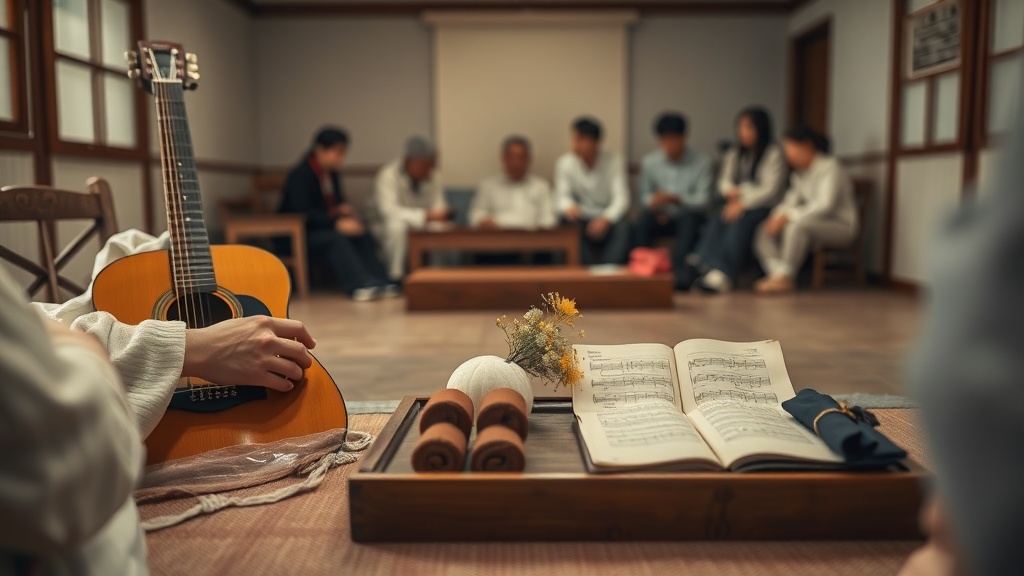
Because acoustic guitar and 7080 songs were central, the evening illustrated how music and memory become links between generations.
Stage and emotion
Emotion flowed.
The younger performers emphasized emotional delivery as much as technical skill.
Tributes by Jeon Yu-seong, and celebratory sets from artists such as Wi Il-cheong, Kang In-won, Jang Eun-ah and Shin Hyun-dae went beyond entertainment to convey solidarity and encouragement.
Namgung Ok-boon’s remarks made clear that the night was a salute to those who preserved acoustic guitar music and the 7080 culture.
The performers’ acts were gestures of gratitude and promises for the future.
Lee Moon-se's songs summoned strong audience memories and invited listeners to rediscover lyrics as markers of time.
However, commentators also suggested that the comfort such stages provide becomes more meaningful if it connects to concrete care for older artists.
Praise and gratitude
Thankfulness was everywhere.
The applause for the two leaders of Twin Folio was not merely polite formality.
The younger artists’ performances recalled musical turning points and social contexts in which those songs mattered.
Fans and colleagues singing past hits together became a shared recognition of cultural heritage beyond individual careers.
The expressed gratitude also pointed to an obligation of passing traditions on.
Music preserves records and memories, and the night's performances read like a commitment from a new generation to keep their elders' names and work alive.
Therefore, the event served as more than celebration: it was a pledge toward cultural sustainability.
A critical view
It deserves reconsideration.
Not all applause carries only positive light.
Some observers warned that large public celebrations can create pressures on personal health and privacy, or risk becoming mere fan service or empty ritual.
On the other hand, critics argued that praise for aging stars must lead to genuine care and institutional support, not just stage moments.
Critique intensifies when ceremonial parties are separated from practical support.
The performances are beautiful, but if the visible stage repeats without sustainable systems for care, gaps in health and support may become apparent.
Accordingly, questions arise about social safety nets, institutional protections for artists, pensions, and connections to medical and long-term care.
Finally, there is a caution about turning public tribute into consumable narrative.
For example, it is important to avoid performances that simply prolong fame or replicate age- and gender-based bias.
These criticisms are not meant to diminish the stage, but to insist that longevity celebrations accompany real-world support.
The defenders’ response
The praise side offers a different logic.
The main argument is about cultural continuity and communal solidarity.
Supporters say these eighty-year celebrations confirm the music community's history and act as an expression of gratitude from juniors to seniors.
Each song onstage summons memories and functions as a way to teach younger artists about musical roots.
Advocates also believe public celebration helps shift social perceptions.
Seeing older artists onstage fosters intergenerational conversation and is therefore more than mere performance; it reiterates a public virtue.
Moreover, when internal industry solidarity attracts institutional attention, it could expand into real welfare and support systems.
Voices from the scene
People spoke directly.
Backstage, Yun Hyeong-ju said, "People told us they hope we stay healthy so they can see Twin Folio perform again."
His remark blended personal hope with a reaffirmation of encouragement from juniors and fans.
Like Namgung Ok-boon's comment, many at the event felt the evening was possible because acoustic guitar music and 7080 culture had been preserved.
Performances by Jeon Young-rok, Lee Moon-se, and others became more than repertoire; they were moments of emotional exchange.
Audience members revisited their youth through song, and those private recollections converged into collective memory.
In that process, the concert delivered comfort, thanks, and promises all at once.
Cultural implications and policy
This calls for thought.
The event raises questions beyond the success of a single night—about cultural policy and institutional support.
As the artist population ages, public and private sectors must discuss how to design care and welfare that include artists.
That conversation should cover better access to pensions, healthcare, long-term care services, guaranteed performance opportunities, and support for creative work.
A promise voiced in song should turn into policy promise.
Voices asking that concerts and tributes not remain anecdotes but connect to social-welfare systems deserve attention.
Designing mechanisms so fans’ and peers’ encouragement becomes real livelihood security is a central task.
Conclusion
To summarize.
The 80th celebration for Yun Hyeong-ju and Song Chang-sik was more than a party; it revealed the pop and folk world's history and intergenerational bonds.
The younger artists’ performances delivered gratitude and comfort and confirmed the passing of cultural memory.
However, the question remains whether this admiration will lead to sustainable support.
Respect offered onstage gains full meaning only when complemented by institutional safety nets and practical measures of care.
Longevity honored in song must be completed by institutional care.
After reading this, how do you judge the event: a cultural commemoration or a signal that institutional change is needed?
