The 2025 MAMA Awards in Hong Kong became controversial because it took place just days after a deadly fire.
Two days earlier, a large blaze at Wong Fuk Court in the Tai Po district killed at least 128 people.
The organizers said they would go ahead with the show but shift the focus to remembrance and support.
The stage was redesigned to emphasize mourning and solidarity rather than spectacle, drawing global attention.
“Silence on Stage: Between Anger and Comfort” The MAMA Awards’ Choice
What happened
The fire occurred on November 26, 2025.
It broke out two days before the awards ceremony, creating a conflict between a cultural event and public mourning.
In the early hours of November 26, a major fire swept through the high-rise public housing complex Wong Fuk Court in Tai Po, Hong Kong.
Local reports and preliminary investigations indicated that the flames spread rapidly through the building, and rescue operations encountered heavy casualties.
Media outlets reported a minimum of 128 deaths, with hundreds more missing or injured.
The incident is being described as the worst residential fire in Hong Kong since the mid-20th century and has left the city shaken.
Meanwhile, the MAMA Awards began in 2009 and has become one of Asia’s biggest pop music ceremonies, closely tied to the international rise of K-pop.
The 2025 ceremony was set to mark MAMA’s return to Hong Kong after seven years, which had already attracted wide attention.
After the fire, CJ ENM, the South Korean entertainment company that stages MAMA, held urgent internal discussions about whether to proceed.
They ultimately decided to continue with the event but to overhaul the production and make remembrance and solidarity the central theme.

History and significance
This is a major event.
Holding the show in Hong Kong carried symbolic weight beyond the choice of venue.
Since its launch in 2009, the MAMA Awards has grown into a large festival that showcases K-pop’s entry into global markets and connects industry networks with fandoms.
Over time it moved from being simply an awards show to becoming a cultural crossroads where artists, business, and fans intersect.
Therefore, returning to Hong Kong in 2025 was more than a logistical decision: it was meant to signal cultural ties and regional engagement.
However, the tragedy that struck just before the show complicated that meaning.
When a cultural event occurs alongside a disaster, organizers cannot only worry about entertainment value; they must also rethink their social responsibilities.
Meanwhile, local residents and broader audiences react in different ways.
Some see music and public gatherings as forms of comfort and communal healing, while others feel a large event so soon after a catastrophe is inappropriate.
These mixed feelings form the crucial context for how the event was managed.
Response and mourning
The ceremony was significantly altered.
They also pledged financial support for victims and recovery efforts.
CJ ENM canceled or scaled back much of the original spectacle.
The red carpet and some fan events were called off to minimize mass gatherings.
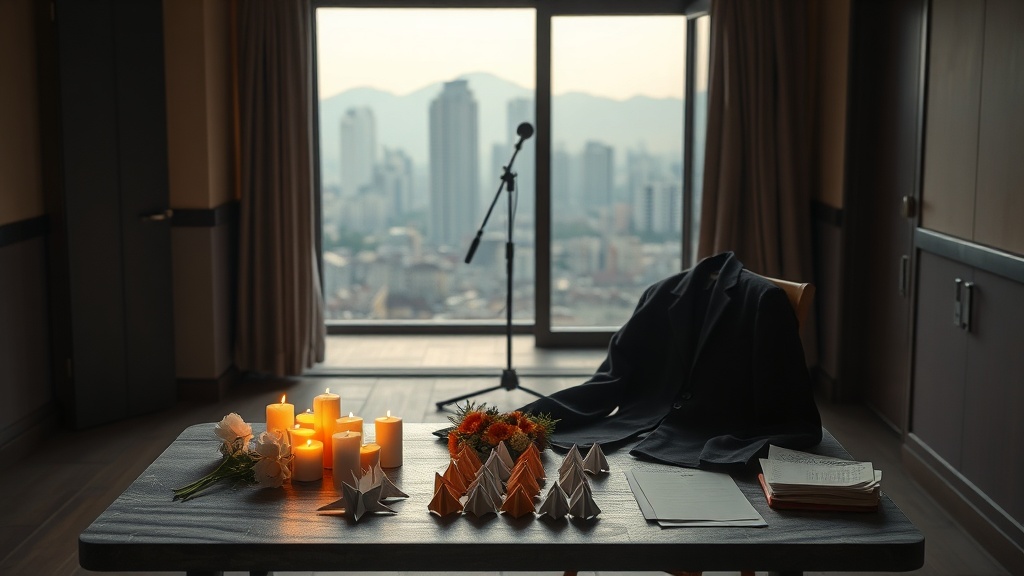
Out of respect and safety concerns, the production adopted a restrained visual language: dark suits and moments of silence became central to the program.
Hosts, presenters, and performers adjusted scripts and staging to reflect the mood of mourning.
Hosts such as actor Park Bo-gum and actress Kim Hye-soo, and presenters including Hong Kong actor Chow Yun-fat, appeared on stage in black suits to lead moments of silence and offer condolences.
Several performers altered lyrics or stripped back theatrical elements in consideration of the victims.
CJ ENM also announced a donation equal to about 3.8 billion Korean won (roughly 20 million Hong Kong dollars), framing the gift as material support rather than mere symbolism.
Some praised this as a meaningful contribution to relief and recovery.
Arguments in favor
Music can console.
Proponents say cultural events play an important psychological and social role after disasters.
Large gatherings can help form shared emotions and public memory, turning private grief into collective remembrance.
When an event actively centers mourning—by toning down spectacle and emphasizing tribute—it can become a vehicle for solidarity rather than a show of insensitivity.
Moreover, the organizers’ financial pledge and program changes were presented as concrete steps beyond symbolic gestures.
Advocates also point out the economic ripple effects of canceling a major event: producers, stage crews, equipment providers, hotels, and transportation services had already invested time and resources.
Rather than wiping out those livelihoods, modifying the event preserved jobs and offered income continuity for many workers in the entertainment supply chain.
From this perspective, changing format instead of cancelling can balance compassion with practical responsibility.
Arguments against
Proceeding raised serious concerns.
Critics emphasized the issue of timing and sensitivity.
With so many grieving and dealing with loss, staging a major entertainment event—even a subdued one—can feel like a public rush to celebration.
Scenes of a large ceremony could be read as lacking empathy, and some family members and residents publicly said they needed more time for private mourning.
There were also practical concerns about rushed production changes.
Normally, complex staging, rehearsals, and safety checks take weeks or months.
Rapidly altering a show can reduce quality and even increase safety risks, which in turn could disappoint fans and undermine public goodwill.
Finally, critics said that when an external organizer makes decisions without thorough consultation with local communities and victims’ families, it risks deepening tensions rather than healing them.
Causes and online reaction
The causes are complex.
Preliminary analysis suggests the tragedy resulted from a mix of factors: building layout, the adequacy of fire safety systems, and the challenges of dense residential living.
As a result, experts and residents are calling for comprehensive reviews of housing safety, firefighting capacity, insurance coverage, and financial support systems for affected households.
In short, the disaster has raised urgent questions about how Hong Kong manages housing safety and emergency response.
Online discussion quickly split between condolences and heated debate over the awards.
Some praised the organizers’ pledge and the calming role music can play, while others criticized the decision as premature and insensitive.
The overall mood online was layered: a few loud voices dominated parts of the conversation, but many users expressed mixed feelings, acknowledging both the need for memorials and the pain of seeing a large event so soon.
These reactions highlight broader questions: How should cultural institutions meet public sentiment after a disaster? How transparent should donations and decision-making be? And who should have the final say when private events intersect with public mourning? This case will likely be referenced in future situations where organizers face similar choices.
Conclusion and questions
The verdict is not simple.
The ceremony went ahead but was reshaped to emphasize mourning and support.
The organizers’ donation and expressions of solidarity received some praise, yet significant criticism remained about whether any large event should proceed so close to a community tragedy.
Ultimately, the episode leaves a complex lesson about how cultural events exercise social responsibility in times of crisis.
Cultural events must be carefully redesigned when they meet public tragedy.
The immediate challenges are ensuring effective victim support, strengthening building and housing safety, and improving communication with affected communities.
We leave the reader with a question: If you were organizing a major cultural event under similar circumstances, would you cancel it outright or change its format and proceed?
