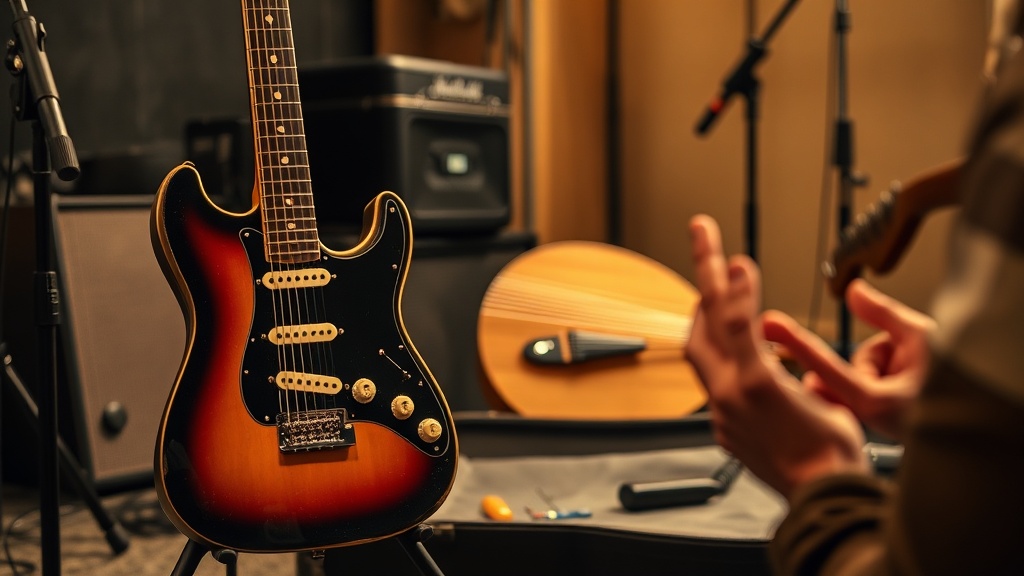
This program pairs his guitar playing with guided commentary on landmark English-language rock songs and notable Korean popular songs.
His stage mixes performance with historical and musical context, creating an educational element.
Therefore, both fans and casual listeners get a chance to deepen their understanding of the music.
Kim Dogyun’s Guitar: Playing the Story
Show overview
The concert takes place on November 29.
Meanwhile, DSM Art Hall in Hapjeong will host two performances at 3:00 p.m. and 7:00 p.m.
He will perform English-language rock classics such as Eric Clapton’s "Wonderful Tonight" and Deep Purple’s "Soldier of Fortune" on guitar.
At the same time, he will reinterpret well-known Korean pop and rock songs from his own perspective.
Kim Dogyun first made his name in his 20s playing with the heavy metal band Baekdusan (Baekdu-san).
He also spent time working in the U.K. with vocalist Im Jae‑bum (a celebrated Korean rock singer), which broadened his musical range.
After returning to Korea he performed with projects such as Asiana and later formed the Kim Dogyun Group.
Thus, he remains an experimental figure within Korea’s rock guitar tradition.

The concert structure alternates between talk and performance.
First, Kim explains a song’s historical background and the composer’s intent, and then moves into a guitar interpretation.
This spoken-performance format targets listeners who want to know the musical context behind what they hear.
Therefore, the event intends to serve not only as entertainment but also as a cultural record.
Why now, and why this format?
Purpose and meaning
The main goal is musical understanding.
Kim Dogyun goes beyond playing notes to explain a piece’s origin, technique, and the era that produced it.
Consequently, this approach expands the audience’s listening experience and adds educational value.
On the other hand, it also becomes a space to reassess rock’s history and public standing.
“Music is a conversation between past and present.”
Kim Dogyun’s concert is an educational stage where commentary and performance meet.
This sentence means the show aims to convey context rather than present a mere list of repertoire.
Moreover, by mixing English-language rock with Korean popular music the program highlights intersections between genres.
For example, his past experiments blending gugak (Korean traditional music) and rock put that crossover into practice.
A single guitarist, many debates
Supportive views
Support is straightforward.
Kim’s technique and commentary deliver a deep musical experience to listeners.
The stage functions as a platform for music-historical interpretation, not just a concert.
Therefore, both serious listeners and learners can benefit.
First, Kim’s long career gives him the technical command to communicate fine details in a piece.
His solo guitar work often reveals facets of the original that help listeners hear differently.
Second, commentary links musical background and compositional intent, letting audiences read a song in new ways.
Third, experiments that fuse rock with gugak point to ways Korean music can expand.
These points show the concert is more than a nostalgia act.
Meanwhile, his TV appearances on variety programs have widened his public reach and attracted casual audiences.
That mainstream presence can make rock more accessible.
In short, supporters argue the show can achieve both musical depth and broader exposure.
What limits or worries exist?
Critical views
Concerns are practical.
Not every audience welcomes a commentary-heavy format.
A program centered on a particular set of genres may alienate some listeners.
Also, fusing traditional music and rock will not feel natural to everyone.
“Mixing tradition and modernity does not guarantee success.”
First, if the program focuses mainly on English-language rock and familiar Korean hits, it may lack genre diversity.
The audience could split into clear camps, and some may find the repertoire repetitive.
Second, successful integration of rock and gugak requires careful arrangements and audience buy-in.
In that process, critics worry traditional source material could be distorted or rock’s identity diluted.
Third, Kim’s variety-show image can sometimes lead critics to question the performance’s artistic seriousness.
Some fans may see his TV persona and doubt the concert’s professional weight.
Fourth, the educational format itself risks losing balance between expertise and popular appeal.
Therefore, critics say the concert might reduce accessibility or create musical confusion for some attendees.
Such worries can be eased by thoughtful planning in programming, arrangement, and audience engagement.
However, it is clear that efforts to include diverse tastes from the planning stage are necessary.
Expanding repertoire choices and arranging with variety can help avoid genre lock-in.
Ultimately, the critique calls for a careful balance between artistic completion and public reception.
Fan and online response, and cultural context
Fan expectations
Fans show both excitement and caution.
They respect Kim’s technique and experimental spirit.
Above all, the combination of commentary and performance promises a different experience from ordinary shows.
Therefore, fans pay attention to both the concert’s musical and symbolic meanings.
Online reactions are largely positive.
Many netizens praise his skill and willingness to take risks.
Meanwhile, questions remain about whether the concert’s expertise will translate into broader popular interest.
Specifically, some worry that a too-specialized program could lose general audience attention.
In cultural terms, the concert helps reframe the history of Korean rock.
Kim’s career marks an important point in the lineage of Korean rock from the 1980s and 1990s to today.
Therefore, this stage acts as an opportunity to read the genre’s narrative anew.
That angle draws interest from music researchers and critics as well.
Value and sustainability of the experiment
Possibility of fusion
Fusion is an experiment, not a formula.
Kim’s attempts to combine rock and gugak show paths for musical growth.
Such experiments can attract new listeners and blur genre boundaries.
However, success depends on persuasive arrangements and audience acceptance.
“New sounds bring both fear and hope.”
In practice, pairing electric guitar with traditional instruments like the gayageum (a Korean zither) can create unique textures and melodic interplay.
But for that synergy to become an artistic consensus requires mutual understanding among performers and time to develop.
Also, persuading conservative fans and traditional-music lovers is an essential part of the process.
Therefore, the concert should keep its experimental spirit while strengthening dialogue with the audience.
Over the long term, these efforts could raise international awareness of Korean music.
If rock that incorporates gugak reaches overseas listeners, it could be noticed as a new, culturally specific genre.
Consequently, the concert’s impact might extend beyond immediate reactions into a longer conversation.
To achieve that, the event should pair performance with documentation, commentary, and media archiving.
Conclusion and questions
Key takeaways
Kim Dogyun’s Music & Talk concert blends live playing with spoken context.
The event carries an educational aim: to help audiences understand musical context.
Supporters see the mix of skill and explanation as deepening musical appreciation.
Critics worry about genre bias and potential loss of mass appeal.
Ultimately, the show’s value depends on careful programming and clear audience engagement.
How performers and producers reflect diverse expectations will decide much of the outcome.
Also, the fusion of rock and gugak should be treated as a long-term experiment to gain meaning over time.
Finally, this stage can serve as a small bridge between the history and future of Korean popular music.
Which perspective will you take when you see this show?
Should the performance favor musical education or popular enjoyment?
Audience choices will help shape where the concert goes next.