Why did this first pitch move the world?
The atmosphere at the ballpark was unlike anything the Dodgers had seen before, from the moment fans queued at the gates.
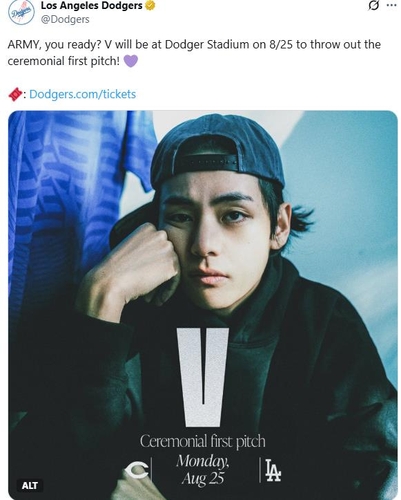
On August 25, 2025, Dodger Stadium filled with cheers hours before first pitch.
When the club announced the guest and MLB amplified the news, the team’s ticket page overloaded within minutes and briefly went offline.
Some reports estimated ticket demand was more than five times normal levels, showing this was more than a routine promotion.
Domestic and international reporters swarmed the stadium, and camera lights never stopped flashing.
Major outlets offered live updates and scene reports, underlining how the moment read as a cultural event as much as a sports ceremony.
In short, V’s first pitch was received not merely as a guest appearance but as a statement about fandom and global attention.
“The crowd made the stage” fits best
The fans were the main act, and the mood felt closer to a concert than a ballgame.
V had completed military service in June 2025 and is preparing for a full-group comeback with BTS; this appearance was widely read as a reminder of his global reach.
The Dodgers promoted the appearance on official channels, and the club later said attendance and related spending rose noticeably around the game.
These figures point to economic ripple effects that go beyond simple fan enthusiasm.
On the other hand, observers noted the event blurred lines between sport and entertainment.
A K-pop (Korean pop music) icon on the mound can foster cultural exchange and goodwill, but it also raises questions about what the baseball ritual should represent.
Some fans welcomed the crossover. However, others worried the spectacle could overshadow the sport itself.
Small ripple to a bigger wave
A single ceremonial pitch foreshadowed wider changes as the points of contact between culture and sport multiplied.
Traditionally, first pitches (the ceremonial toss that opens a baseball game) have featured athletes, civic leaders, or local celebrities. Meanwhile, this time a global entertainment star turned the mound into a fandom festival.
Unlike past moments when Korean-born pitchers or players—such as Chan Ho Park or Ryu Hyun-jin—were involved, this event centered on an entertainer rather than a baseball figure, and that difference matters.
From the club’s perspective, the move looks like a strategy to reach new audiences and boost brand value.
Ticket demand surges, increased spending in nearby businesses, and expanded media visibility can all deliver short-term economic gains for the neighborhood and the franchise.
Conversely, some traditional baseball fans say celebrity-focused activations risk distracting from the gameplay and the sport’s rituals.
The city took a calculated risk
The choice reflected a deliberate experiment: bringing a cultural phenomenon into a major American sports setting.
Many analysts read the Dodgers’ decision as a strategic push to compete in a global entertainment market and to deepen engagement with younger, international fans.
The plan diversifies the live experience both inside and outside the stadium, and thus appears aimed at long-term audience development.
However, real-world constraints emerged that day: ticketing servers slowed or failed, traffic near the ballpark worsened, and some attendees reported delayed entry.
These operational problems suggest organizers underestimated the scale of demand and the logistics of managing a fandom of this size.
Therefore, future events will need stronger crowd-control plans and more robust online infrastructure to protect fan safety and venue operations.
“Change brings opportunity and risk”
Change always has two sides: opportunity and risk coexist.
Supporters argue V’s appearance promoted cultural exchange, raised Korea’s profile, and produced measurable economic benefits in ticketing and local commerce.
In their view, a shared event where pop culture and sport overlap can energize both fan communities and create memorable experiences.
On the flip side, critics warn that such spectacles can erode the core sporting experience, pointing to commercialization and crowd concentration as dangers.
They stress the need for careful risk management, noting that intense fandom clustering can create safety hazards and upset fans who came primarily for the baseball.
Balancing those concerns requires thoughtful planning, rather than reactive measures after a problem occurs.
Key issues from multiple viewpoints
The episode is more than a single ceremonial pitch; it became a cultural signpost.
It shows how a K-pop star can influence attendance and attention on an American professional sports stage, while also exposing operational and ethical questions about commercialization and fan safety.
From a positive angle, the event expanded cultural exchange, boosted local economic activity, and broadened what a ballpark visit can feel like.
From a critical angle, it raised legitimate concerns about game focus, public safety, and the limits of turning sports venues into entertainment platforms.
These perspectives are not mutually exclusive; instead, they point to a need for balance and stronger planning.
The conclusion is not simple; it asks a question
The bottom line is balance: opportunities must be managed alongside risks.
V’s first pitch flagged a constructive blending of K-pop and American sport, yet it also prompted necessary questions about safety and the preservation of the game’s essence.
Going forward, similar events should combine strong crowd-safety protocols, improved operational readiness, and respect for the sport’s traditions.
At the same time, these moments can lay groundwork for sustained cultural exchange, introducing K-pop and Korean culture to new American audiences.
Finally, we should ask: do you welcome this kind of cultural crossover in sports, or do you see it as distracting from what the game is meant to be?
V’s August 25, 2025 first pitch at Dodger Stadium became more than a ceremonial toss. It amplified K-pop’s reach into American sports, delivered economic spikes in ticket demand and local activity, and exposed operational and safety challenges. Future events of this kind will need stronger planning to protect fans and preserve the sport’s core values.
