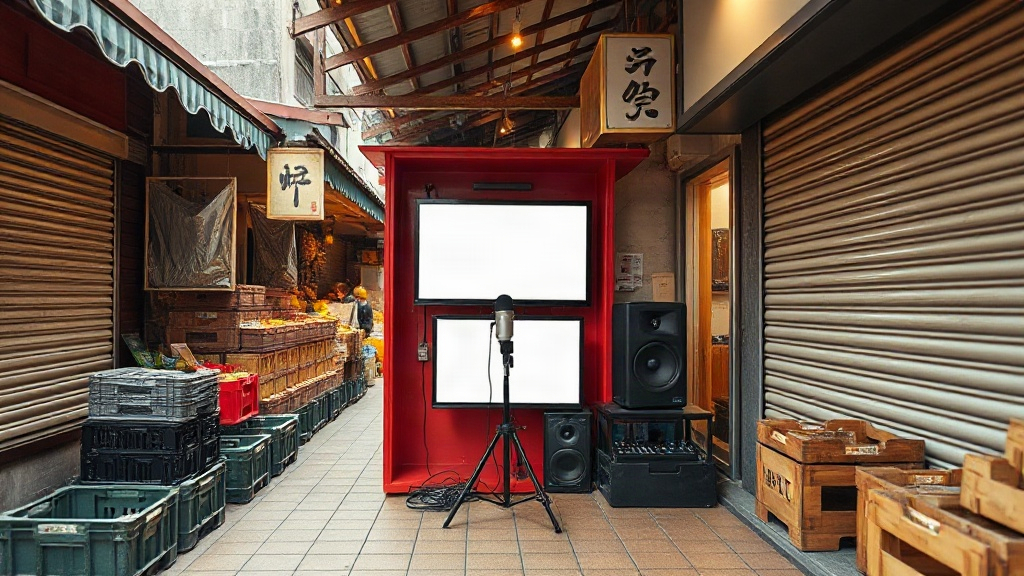
Jinju Traditional Market in South Gyeongsang Province is getting a village broadcast booth. The plan is for merchants and residents to take part directly, share market news, introduce individual shops, and make the market feel like a more familiar part of daily life. On the surface, it sounds modest. In practice, it may be an experiment in how people are encouraged to see a traditional market.
A market is never only a place to buy and sell. It is also where local routines, small business fortunes, and neighborhood conversations overlap. Jinju’s broadcast booth is aimed at that layer of life. The real question is not simply that a booth is being built, but who will use it and what kind of voices it will amplify.

A local broadcast space is being added to Jinju Traditional Market
The confirmed facts are straightforward. A village broadcast booth is being established in Jinju Traditional Market, with merchants and residents participating directly. It has been introduced as a way to share market news and promote shops. The report is attributed to Yonhap News, and the supplied link is dated September 4, 2026.
What stands out is the decision to create a new media space inside a market. Instead of presenting only goods on shelves, the idea is to carry stories, daily updates, and shop introductions alongside the merchandise. That gives the market a more approachable channel for information and could make the place feel less anonymous to visitors.
The participatory design matters too. If merchants and residents are involved from the start, the booth is not just an outside promotional tool dropped into the market. It becomes something made from within, which fits the logic of a neighborhood space more than a top-down advertising campaign.
Can a promotion tool also serve the public good?
The upside is easy to see. Market news and shop information could become easier to hear, and even smaller stores would have a way to introduce themselves. If the stories inside the market are carried outward, the market may start to feel less like a one-time destination and more like a place people return to as part of ordinary life.
But the bigger the promise, the sharper the questions. Who will operate it? Who will produce the content? Who actually gets the microphone? The material provided does not spell out the operating body, production method, budget, technical equipment, or the full scope of participation. For now, the project should not be oversold.
That matters because once shop promotion becomes the dominant function, balance can slip. If information sharing gives way to pure exposure time, the booth could stop feeling like a shared civic platform and start looking like a louder channel for a few select stores. Whether it broadens the market’s voice or narrows it will shape how the project is judged.
The outcome will depend on how the booth is run
A broadcast booth alone will not revive a market. Whether it leads to more visitors or lasting commercial energy is a separate question. Community-based projects rise or fall on steady staffing and regular content, and if the effort fades after the initial launch, the idea will quickly lose force.
So the project should be measured by two standards at once. One is the clear advantage of giving the market a new way to speak. The other is the condition that it must operate broadly and consistently if it is to matter. When merchants and residents move from symbolic participation to real participation, the booth can become a public language for the market.
In the end, Jinju’s village broadcast booth can be read either as an attempt to rebuild local community or as a shop-promotion project. Which reading wins depends on the operating model. The useful part is obvious enough: it may help the market sound more alive. But it should not be mistaken for a cure-all. The test begins once the microphone is actually turned on.
