The first outdoor special on The Seasons shows how far the format can stretch.
Once a music talk show leaves the studio, it gains a stronger sense of place.
However, an open-air setting also brings new risks with the excitement.
This episode asks how culture meets the city, and what it costs to do so.
News that KBS 2TV's music talk show The Seasons will stage its first outdoor special on the Han River drew attention with just a few lines of copy.
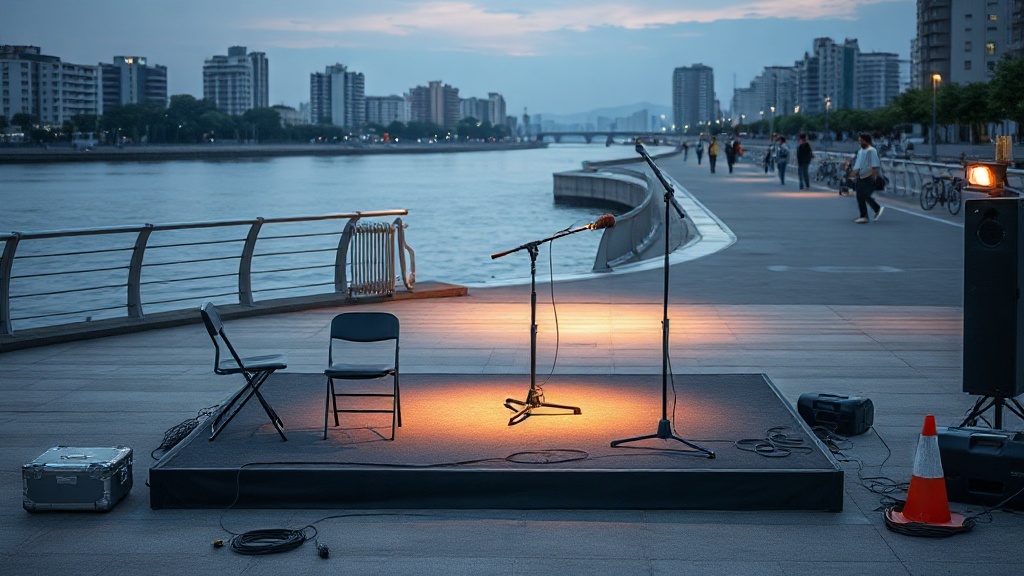
On June 5, the program will move into the open air and place one of Seoul's most recognizable public spaces front and center.
That simple shift matters.
It is not just a live taping outside the studio; it feels like a statement about how culture can claim space in a city.
What makes this moment stand out is not some grand revolution.
It is something smaller, and clearer.
For decades, TV has leaned on polished indoor sets, controlled lighting, and predictable acoustics.
The Seasons is nudging that formula outward, letting real air, real movement, and real crowd energy enter the frame.
Broadcasting no longer ends inside the screen.

The Han River is more than a backdrop.
It is a public corridor where people walk, rest, run, and gather across the day.
Putting a music talk show there means the performance is syncing itself with the rhythm of the city.
In that sense, this special episode is both a programming choice and a test of how far culture can travel outside its usual walls.
Studio comfort or open-air energy
The appeal is obvious.
Supporters of outdoor broadcasting usually start with one word: presence.
Music often stays in memory not only because of the sound, but because of the air around it.
A carefully mixed studio performance can be beautiful, of course.
However, a river breeze, moving crowds, and distant city noise create a different emotional register.
That mix can turn a good show into an experience people remember.
The Seasons is built on more than songs.
It also depends on conversation, mood, facial expressions, and audience response.
Outdoors, all of that becomes more visible.
The audience is no longer just watching from the other side of the frame.
It becomes part of the performance itself.
That is why the Han River special feels bigger than a one-off event.
An open space invites participation.
People feel less distance between the stage and the seats.
They move into the program more naturally, almost without noticing the boundary.
For a public broadcaster like KBS, that matters.
A public broadcaster does not only send signals into homes; it is also expected to widen access to cultural life.
There is also the power of location.
The Han River changes with the season, the hour, and the weather.
Those shifts give a live broadcast a unique pulse.
Even viewers who usually skip music programs may find the setting easier to enter.
In that sense, the outdoor special is less a gimmick than an invitation.
It is the width of the contact it creates.
By moving to the riverbank, the broadcast lets music breathe in the city air.
But the risks are real.
The other side of the argument is just as clear.
Outdoor TV may look elegant, but elegance has a price.
The biggest one is weather.
Inside a studio, producers can control the lights, sound, camera angles, and movement.
Outside, a gust of wind, rising humidity, or even nearby noise can become part of the show.
For a music program, sound is everything.
A small crackle, a strange echo, or an unexpected burst of noise can flatten the whole mood.
The Han River offers openness, but openness is harder to manage.
If crowds grow too large, safety planning gets more complicated.
If movement paths are not carefully designed, the sense of flow can break down quickly.
The production burden is heavier too.
Indoor shows can repeat a designed setup.
Outdoor shows have to read the scene from scratch each time.
That means more labor, more time, and more money.
If the price of one eye-catching event is a system that is too costly to repeat, then the format deserves a hard look.
So the criticism is not simply, Do not do it.
It is closer to, Why take on so many outside variables if you do not have to?
If the performance is strong but the logistics wobble, viewers may remember the instability before they remember the music.
That would weaken the case for the next special.
New form should not outrun stability.
This debate is not only about television production.
Across culture today, creators keep balancing studio safety against the energy of live spaces.
The same tension appears in work, education, and even family life.
People want something predictable, but they also want something alive.
That is why The Seasons special feels larger than entertainment trivia.
Those who support it see expansion.
Those who question it see cost.
Both readings make sense.
The important thing is to hold them together.
Culture keeps changing, but change does not automatically equal success.
What changes when music meets the city
The city responds.
The deeper meaning of a Han River stage is the conversation between music and place.
The city offers the stage, and the stage changes how the city is seen.
That back-and-forth is where cultural content gets its strength.
People gather because of a famous location, then remember the emotions that formed there.
The first outdoor special on The Seasons shows how that memory is made.
The goal is not only ratings.
It is turning a specific night and a specific place into an event people feel they were part of.
Watching music by the river leaves a different impression from watching it in a studio.
That impression is emotional, not just informational, which is why it tends to linger.
For KBS, the special also brings public value into view.
Public value is not a slogan.
It means creating a place where many people can enter, watch, and attach their own feelings to the same moment.
In that sense, the outdoor special is a small experiment and a big offer at once.
Of course, experiments only matter if they can be repeated.
Safety planning, crowd flow, sound control, and coordination with the neighborhood all have to be in place.
Without that, the new format becomes a one-night novelty and nothing more.
Sustainability gives innovation its real force.
Music talk shows are built on the meeting of words and songs.
When a wide river landscape is added, the words travel farther and the songs seem to last longer.
The difference may look subtle on paper.
But for viewers, it can change how the whole night feels.
In the end, people often remember not the production logic, but the sense that they were inside the moment.
The reason is simple.
Culture is remembered less through explanation than through experience.
That is where the Han River special finds its pull.
People remember scenes longer than facts.
Sometimes a single scene changes how a city is seen.
Will this stage succeed or stay a question
The verdict is still open.
In the end, The Seasons first outdoor special carries three clear meanings: a wider format, stronger live energy, and the use of a landmark place with public visibility.
At the same time, weather, safety, sound, and cost remain serious concerns.
That is why this should be watched with balance, not just applause.
Still, one thing is obvious.
This episode is an experiment in how far a music talk show can open itself up, and a reminder that public broadcasting is also about how it meets the public.
The question that begins on the Han River reaches beyond one program.
It touches the relationship between city and culture, community and public access.
So the real issue is not whether this special is flashy.
It is whether a live cultural moment can stay open without losing its footing.
Would you see this kind of outdoor special as a wider doorway for culture, or as a risky distraction from stability?
